Visiting Assistant Professor of Philosophy at Hobart and William Smith Colleges
Courses
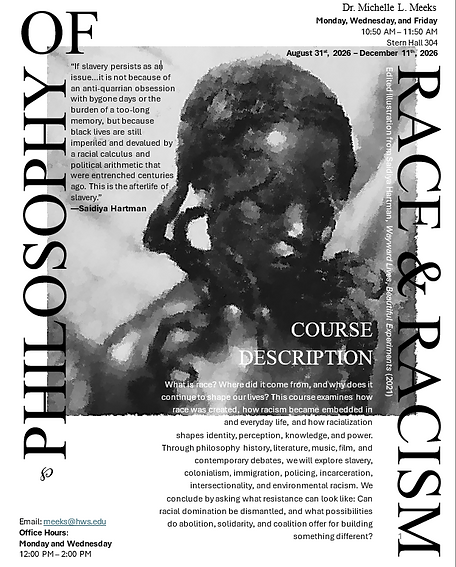
PHIL 210: Philosophy of Race and Racism
Critical Philosophy of Race and Racism, FA 26
Hobart and William Smith Colleges
What is race? Where did it come from, and why does it continue to shape our lives? This course examines how race was created, how racism became embedded in institutions and everyday life, and how racialization shapes identity, perception, knowledge, and power. Through philosophy, history, literature, music, film, and contemporary debates, we will explore slavery, colonialism, immigration, policing, incarceration, intersectionality, and environmental racism. We conclude by asking what resistance can look like: Can racial domination be dismantled, and what possibilities do abolition, solidarity, and coalition offer for building something different?
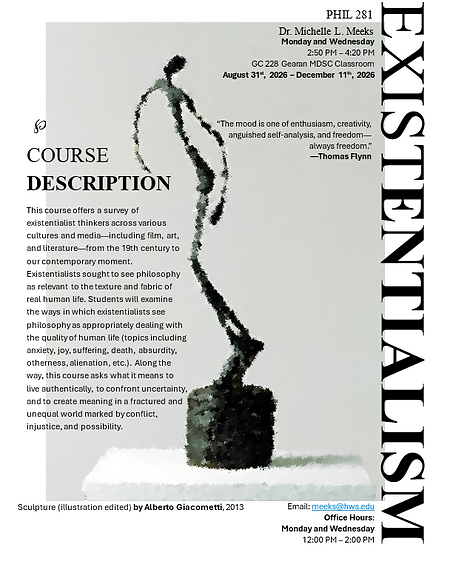
PHIL 281: Existentialism
Existentialism, FA 26
Hobart and William Smith Colleges
This course offers a survey of existentialist thinkers across various cultures and media—including film, art, and literature—from the 19th century to our contemporary moment. Existentialists sought to see philosophy as relevant to the texture and fabric of real human life. Students will examine the ways in which existentialists see philosophy as appropriately dealing with the quality of human life (topics including anxiety, joy, suffering, death, absurdity, otherness, alienation, etc.). Along the way, this course asks what it means to live authentically, to confront uncertainty, and to create meaning in a fractured and unequal world marked by conflict, injustice, and possibility.
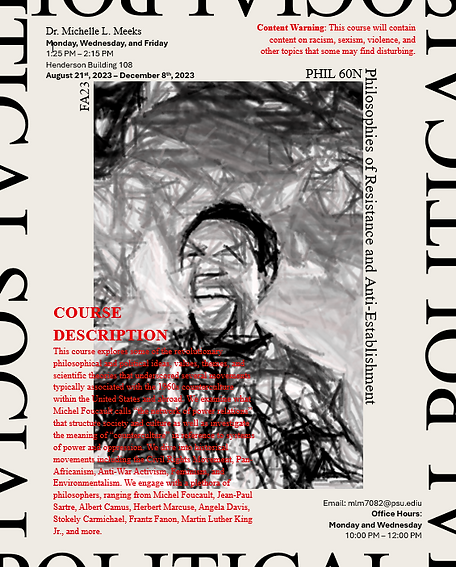
PHIL 060N: Philosophy & 1960s Counter Culture
Philosophies of Resistance & Anti-Establishment, FA 23
The Pennsylvania State University
This course explores some revolutionary philosophical and political ideas, values, themes, and scientific theories that underscored several movements typically associated with the 1960s counterculture within the United States and abroad. We examine what Michel Foucault calls “the network of power relations” that structure society and culture and investigate the meaning of “counterculture” in relation to systems of power and oppression. Hence, this course poses several questions about systems of oppression and repression, (anti-)establishment, (anti-)capitalism, racism, sexism, imperialism, revolution, and coalition. We dive into historical movements, including the Civil Rights Movement, Pan-Africanism, Anti-War Activism, Feminism, and Environmentalism. We engage with many philosophers, including Michel Foucault, Jean-Paul Sartre, Albert Camus, Herbert Marcuse, Angela Davis, Stokely Carmichael, Frantz Fanon, and Martin Luther King Jr.
Students will examine original texts and experience other forms of media to enhance their understanding of these central philosophical and social scientific theories.
Finally, this course's fundamental objective is to interrogate how the cultural, social, and political movements that defined this period ultimately shaped our contemporary situation.

PHIL 005: Philosophy & Film
Philosophy & Horror, FA 22
The Pennsylvania State University
This course explores and interrogates a vast and challenging array of philosophical themes in contemporary horror films. We explore how the horror film genre acts as a medium to reveal ethical dimensions of reality, being, humanity, gendered identity, consciousness, society, culture, and history. The most prominent of themes are race, masculinity, femininity, sexuality, depression, trauma, repression, grief, ethics, motherhood, religion, capitalism/consumerism, and the ways in which each of these themes connects, overlaps, and intermesh. Each film is explored philosophically, as well as psychoanalytically.
Anonymous Reviews:
"The Philosophical discussions each week really helped me understand how to look at a film from a philosophical perspective. That is, the philosophical themes and messages of the film, not just the cinematography, music, and acting."
"The professor's attitude toward class concepts was exceptional. She really clearly cares about her students and makes sure they understand all the interesting discussions we have in classes."
"This was probably my favorite course I’ve ever taken at Penn state. The movies were incredible, class discussion was interesting, and engaging while also feeling like I was learning something. A super fun class that I was always excited to go to. Our Professor made the class so comfortable and fun and easy to speak up in."
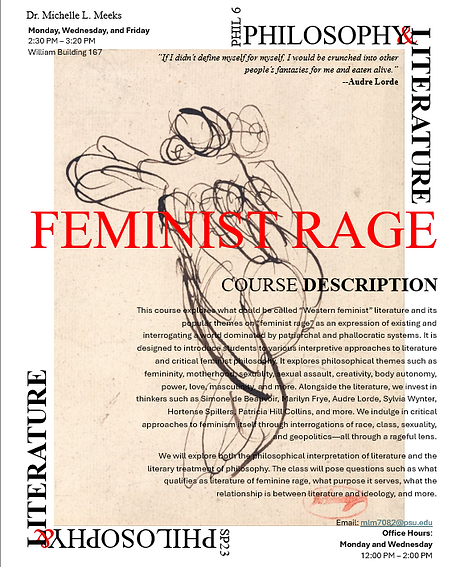
PHIL 006: Philosophy & Literature
Feminine Rage, SP 23
The Pennsylvania State University
This course explores literature that centers on feminine rage as a major source of existing and interrogating a world that orchestrates against you. It is designed to introduce students to various interpretive approaches to literature and critical feminist philosophy. Alongside the literature, we invest in thinkers such as Simone de Beauvoir, Marilyn Frye, Audre Lorde, Soraya Chemaly, Julia Kristeva, Maria Lugones, and more. We indulge in critical approaches to feminism through interrogations of race, class, sexuality, and geopolitics—all through a rageful (yet constructive) lens. We explore themes such as femininity, motherhood, sexuality, sexual assault, creativity, body autonomy, power, love, masculinity, and others.
Anonymous Reviews:
"This course was discussion focused and allowed for students to share their understanding of the material and course content. I found the immersive, social aspect of this course to be critical for my learning as I was able to learn from both my professor and my classmates. Hearing the different perspectives and thought processes of my fellow classmates when discussing the topics within this course was extremely insightful. I also found the professor to be the most critical aid in my learning experience. Not only did she provide and explain the course material very thoroughly, but she also was a great support system throughout the semester."
"Thoroughly engaging discussion and Professor Meeks was very enjoyable to interact with! It was a very healthy environment and our topics of discussion were rather broad, however, it was difficult not to be interested in what was being discussed."
"I found this entire course to be very enjoyable. Ms. Meeks made the learning environment so inviting, she made sure that every opinion could be heard. This also really helped me learn, because everyone voicing opinions in respectful ways really allowed me to grasp different perspectives that I otherwise may have been aware of."
"This class introduced me to multiple different philosophical feminist texts and helped me to understand them, which gave me the tools and vocabulary to analyze different pieces of media through the perspective of feminine rage. I appreciated how the course began with many philosophical readings so we could go back to reference those throughout the semester, as well as adding on additional pieces to read with specific media as we went on. I really enjoyed our class discussions and how they were almost always a blend of lecture and discussion, and how our professor genuinely interacted with us and our ideas. Our discussion posts were helpful to continue thinking about the media we looked at in-depth, and I appreciated that they were not too hard to get done."

PHIL 001: The Big Questions
Metaphysics & Epistemology, SP 22
The Pennsylvania State University
I teach this course with the intention of centering POC, Black, Feminist, and nonheteronormative epistemologies and metaphysics. I encourage my students to think about and interrogate some of the assumptions of canonical figures in the tradition-- figures such as Heidegger, Foucault, Camus, Sartre, and other European thinkers. This course places these figures in dialogue with thinkers such as Marilyn Frye, Maxine Sheets-Johnstone, Audre Lorde, W.E.B. DuBois, Frantz Fanon, and others.
Anonymous Reviews:
"The quizzes and chosen literature were fantastic for understanding the material of the course..."
"I thought the layout of this course was super beneficial. It helped me learn and understand the material easily and quickly. I enjoyed the discussions every Friday."

PHIL 003: Ethical Life
Under Systems of Oppression, SU 23
The Pennsylvania State University
This course has several key objectives. The first objective is to offer students an inexhaustive overview of the philosophical tradition of ethics and moral reasoning. It examines key philosophical figures such as Aristotle, Immanuel Kant, Jeremy Bentham, Jean-Paul Sartre, and Friedrich Nietzsche. Its second objective is to interrogate this tradition through a marginalized and oppressed framework, provoking the question, what is ethical life and what does it look like under systems of oppression? Part two of this course is grounded in questions such as, is ethical life possible under Capitalism, Imperialism, and Colonialism? What is the tension between ethical life and racism, misogyny/ misogynoir, disability, xenophobia, and homo/transphobia? What role does the European tradition play in blurring this tension? By interrogating these questions with the help of marginalized philosophers, this course seeks to offer students the vocabulary and perspective to critically formulate their moral philosophies.
Anonymous Reviews:
"I love Professor Meeks' teaching style. She is so relatable yet insightful. I was extremely nervous to take Philosophy because I struggle with ADHD, and that makes reading hard. However, Professor Meeks discusses the important ideas in the texts and makes them very manageable for me to follow. I really appreciate the way this class works and cannot find a critique or flaw. I really appreciate how caring Professor Meeks is and how she makes me feel comfortable to ask questions even when I am afraid of sounding stupid."
"I genuinely love this course. I enjoy watching a movie/documentary on Mondays, having class discussions and text analyses throughout the week, and debates on Fridays. I believe all teachers should teach this way because of how engaging and enjoyable this class is for me. My favorite part about this class is the debates. I like how we are able to express our opinions instead of just talking about old philosophers. I feel comfortable saying my true opinion, and I have gained new perspectives from the debates which is very valuable to me. I find the course to be the perfect difficulty. While the texts are honestly difficult for me to understand, when they are discussed in class, I am able to grasp the concepts."
"I liked every aspect of this course. The lectures, discussions, debates and even the movies very much helped me understand the complexities of philosophy. Some of the readings, especially the earlier ones, were hard to digest, but the lectures really helped me understand them a lot more in depth. The lectures were always extremely interesting to me, even if I didn't understand EVERYTHING being discussed. As for the discussions and debates, I found it very beneficial to listen to everyone else's opinions, even if I didn't agree with them... I felt like most of us were engaged and participated a lot of the time. Aside from all that, I think Michelle is a GREAT teacher! She is skilled in creating a positive and comfortable environment for her students, and she often engages with them in very meaningful ways. She was always more than willing to talk after class if we had any questions or if we even wanted to just talk about other things going on in our lives. I give her the highest of praises! Overall, I very much enjoyed philosophy, and I'm grateful that it was my first class at Penn State"
"I loved this class so much. I loved the discussions we had, I feel like I got to know my peers very well and also helped practice engaging in conversations with someone with an different opinion and how to thoughtfully and productively discuss our perspectives. Professor M did a great job teaching us about valuable topics and also creating a safe space where everyone could talk about their opinions without it getting hostile"
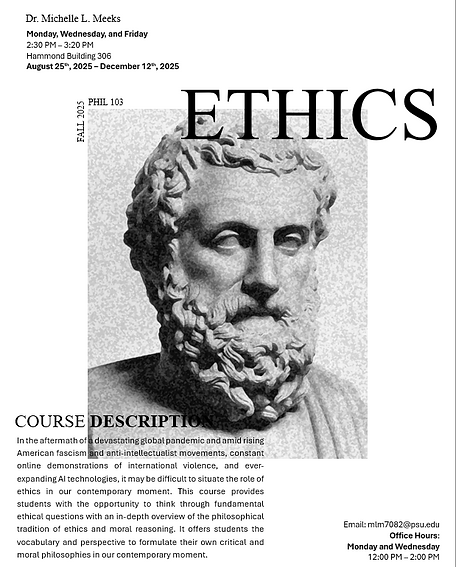
PHIL 103: Ethics
Ethics, FA 25
The Pennsylvania State University
In the aftermath of a devastating global pandemic and amid rising American fascism and anti-intellectualist movements, constant online demonstrations of international violence, and ever-expanding AI technologies, it may be difficult to situate the role of ethics in our contemporary moment. This course provides students with the opportunity to think through fundamental ethical questions with an in-depth overview of the philosophical tradition of ethics and moral reasoning. It offers students the vocabulary and perspective to formulate their own critical and moral philosophies in our contemporary moment.

PHIL: Philosophy & Video Games
Philosophy, Aesthetics, & Video Games, SP 27
Hobart and William Smith Colleges
Under Development.